


We cannot predict the mysterious work of the Holy Spirit. Jesus reminded us that “the wind blows wherever it wants. Just as you can hear the wind but can’t tell where it comes from or where it is growing, so you can’t explain how people are born of the Spirit” (John 3:8, NLT). Church growth is never a formula. It is never a guarantee. It is always, at its core, the gracious movement of God.
But we can learn from the patterns of how the Spirit has worked in churches across generations. We can observe the conditions that often accompany spiritual renewal and numerical growth. And we can pay attention to the practices that consistently place a church in the path of God’s activity.
That is the purpose of the Rainer Predictive Index. It doesn’t replace prayer or dependence. It simply highlights the factors most strongly correlated with growing, healthy congregations.
When these predictors are present, churches tend to flourish. When they are absent, churches often decline.
1. Has at Least Three Outreach Efforts a Year
Growing churches do not drift into evangelism. They schedule it. They pray for it. And they engage their people in it. But an outreach effort is not simply a big event, a seasonal festival, or a service project in the community. Those activities have value, but they do not become evangelistic unless members intentionally invite and connect with potential guests.
That personal invitation is the hinge on which outreach turns. When a church mobilizes its people to pray for others, invite others, and follow up with others, the results are far more consistent and far more transformative.
We have seen this pattern repeatedly, especially as churches adopt The Hope Initiative. What began as a simple tool has become a mainstay in congregations experiencing renewed growth. The outreach is small, steady, and Spirit-dependent—exactly the kind of effort that keeps a church outwardly focused and mission ready.
2. Pastor Committed to Personal Evangelism at Least Twice a Month
When the pastor models evangelism, the church feels it. A congregation rarely rises above the example of its leaders, and nowhere is that more evident than in sharing the gospel. Personal evangelism by the pastor—at least twice a month—creates a quiet but powerful culture where outreach is normal rather than exceptional.
This commitment doesn’t require dramatic encounters or lengthy presentations. It simply requires intentionality: praying for opportunities, noticing people, starting conversations, and following up. Over time, the pastor’s faithfulness becomes contagious.
Churches with evangelistic pastors almost always demonstrate stronger outward focus. The shepherd’s posture becomes the flock’s posture. And a church shaped by that kind of leadership is far more likely to grow.
3. An Active Prayer Ministry That Includes Prayers for an Evangelistic Harvest
Prayer is often called the “first work” of the church, but in growing congregations it becomes an ongoing, intentional ministry. These churches do more than collect prayer requests. They regularly and specifically pray for an evangelistic harvest.
Intercessors lift up names of people far from God. Groups pray over neighborhoods and schools. Leaders ask God to open doors for gospel conversations. The church develops a shared expectation that the Spirit will move and that people will respond.
When prayer is focused on the harvest, the congregation’s heart shifts outward. Members begin to notice opportunities they once overlooked. They become more aware, more compassionate, and more ready. Churches that pray for the lost tend to reach the lost.
4. An Active and Intentional Welcome Ministry
Growing churches don’t leave first impressions to chance. They build an intentional welcome ministry that begins before guests reach the front door and continues long after the benediction. This ministry is more than friendly people handing out bulletins. It is a coordinated effort to notice newcomers, guide them, and help them feel genuinely seen.
Warm smiles matter, but so do clear signs, easy pathways, and thoughtful follow-up. The most effective churches train volunteers to anticipate questions, reduce awkward moments, and create a safe, gracious environment for guests who may already feel uncertain.
When a welcome ministry is intentional, guests return. And when guests return, they often become part of the church’s story—a story that continues to grow.
5. A Specific Celebration at Least Once a Month
Healthy, growing churches find reasons to celebrate. These celebrations are intentional, not accidental. They highlight stories of life change, baptisms, ministry wins, faithful service, answered prayer, or simple moments of God’s grace in the congregation.
The goal is not hype. It is gratitude. When a church pauses at least once a month to recognize God’s work, the entire body is reminded that the mission is active and alive. These celebrations also create momentum. They encourage members who may feel weary and inspire those who may feel disconnected.
In growing churches, celebration becomes a spiritual discipline. It turns attention outward, lifts the eyes of the congregation, and reinforces the truth that God is still moving among His people.
6. Intentionality to Move People to Groups
Growing churches understand that discipleship and connection deepen best in smaller circles. Worship gathers the church, but groups knit people into the life of the congregation. They provide space for prayer, accountability, encouragement, and spiritual growth—things that rarely happen in the same way in a large gathering.
The key is intentionality. People seldom drift into groups on their own. Effective churches create clear pathways, offer regular on-ramps, and personally invite newcomers into communities where they can belong.
When a church consistently moves people to small groups, Sunday school, and other groups, relationships strengthen, believers mature, and guests are far more likely to stay. Groups become the relational backbone of a growing congregation.
7. Demographic Growth in the Community
Demographic growth is not the strongest predictor of church growth, but it remains a meaningful factor. When more people move into a community, opportunities naturally increase. New residents are often open to relationships, spiritual conversations, and exploring local churches. In many cases, they are looking for connection before they look for programs.
Growing churches pay attention to these shifts. They study neighborhoods, new housing developments, school enrollment trends, and local business expansion. They ask what the changing population means for ministry, outreach, and staffing. Most importantly, they prepare to welcome people who may not share the church’s history or traditions.
Demographic growth alone does not guarantee spiritual growth. But when a church aligns its mission with the changing landscape around it, it positions itself to serve its community with greater clarity and effectiveness. The field becomes larger, and so does the opportunity for harvest.
8. Sufficient Space to Accommodate the Most Attended Service
The 80% rule is still a good metric to follow. If the worship center is 80% full, it feels completely full to the attendees. If parking is 80% full, it feels like there is no room to park, especially from the perspective of guests.
Of all the facility challenges churches face today, parking has become the most common blockage to growth. A church may have room in the sanctuary, space in the nursery, and seats available in the classrooms, but none of that matters if people cannot park their cars. Guests rarely circle a lot twice. They simply leave.
That is why every church should evaluate parking capacity for its most attended worship service. Start by counting your parking spaces. Then estimate that each space represents about two people. Finally, apply the 80% factor—because once a lot feels mostly full, people begin to turn away.
Here is a simple example: if your church has one service and 70 parking spots, it can realistically accommodate a worship attendance (all ages on site) of 112.
70 × 2 × 80%.
Parking may seem mundane, but removing this barrier can open the door to new growth.
Interpreting the Rainer Predictive Index
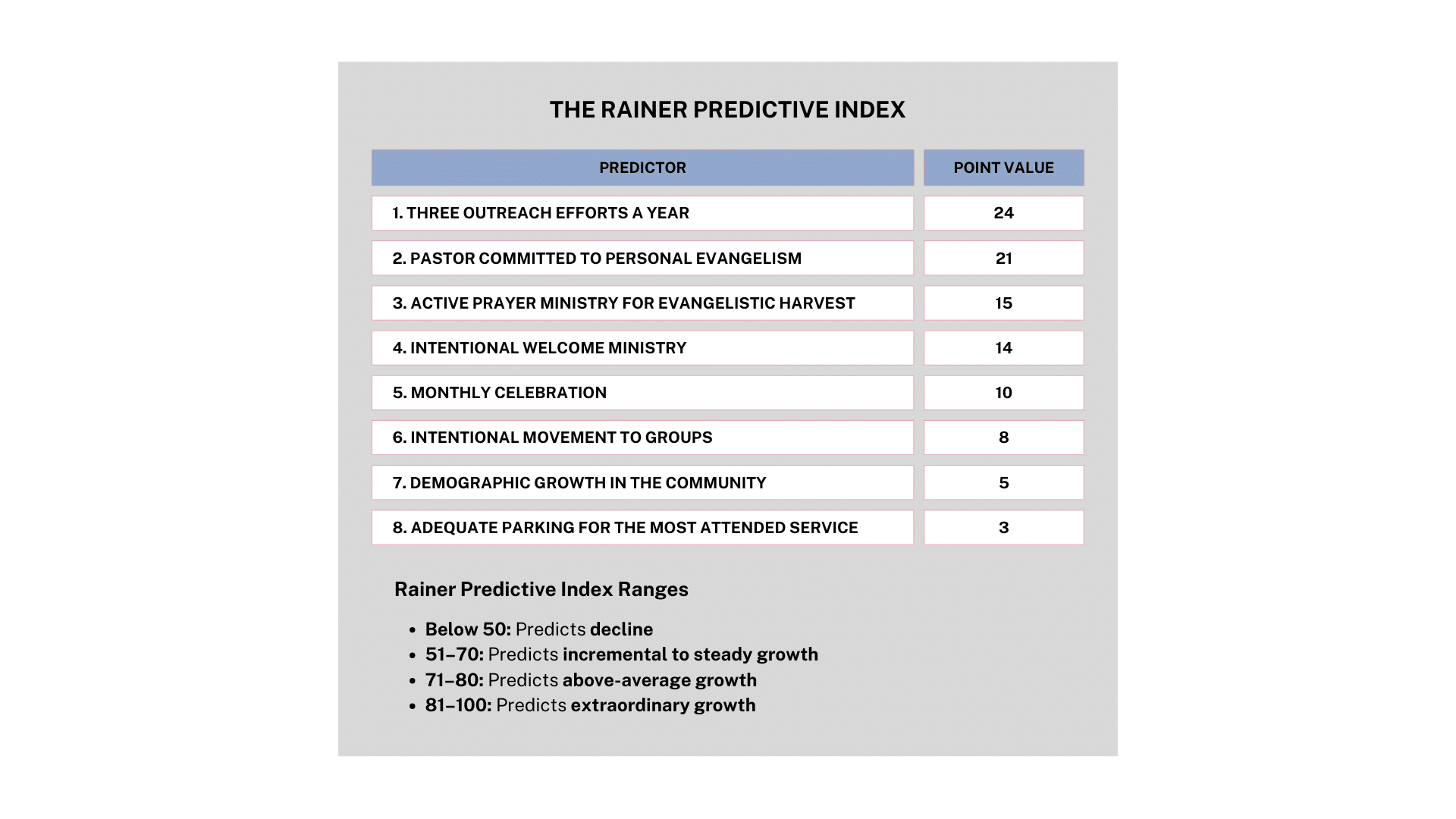
Each of these predictors contributes differently to a church’s overall likelihood of growth. Some have a stronger correlation than others, but together they form a clear picture of a congregation’s readiness to reach people. The Rainer Predictive Index brings these factors together in a simple, practical way. Church leaders can walk through each item, assign the corresponding point value, and total the score.
This is not a formula for guaranteed growth. It is a tool—one that highlights strengths, exposes blind spots, and encourages intentional next steps. When churches understand where they stand, they are far better positioned to lean into the mission with clarity and hope.
Below is the Predictive Index in chart form. After scoring each predictor, compare the total to the Index ranges to determine your church’s likely trajectory.
Posted on December 15, 2025
With nearly 40 years of ministry experience, Thom Rainer has spent a lifetime committed to the growth and health of local churches across North America.
More from Thom
